
Service Pages for Islamabad Businesses: How to Write Pages That Rank

Service pages are the pages on your website that explain what you sell, who it is for and how to get in touch. For most businesses in Islamabad, they are also the pages most likely to rank for searches that lead to real customers, such as “AC repair in Islamabad” or “corporate lawyer in Blue Area”. Yet many sites have one short “Our Services” page with a list of bullet points and no detail. This guide explains how to plan and write service pages that rank on Google and turn visitors into enquiries.
Why one “Services” page is not enough
Google tries to match each search with the page that best answers it. If someone searches for a specific service and your site only has a general page listing ten services in one line each, Google has very little to go on, and the visitor has very little reason to call. A dedicated page for each main service lets you explain it properly, answer the questions customers actually ask and target the words they actually search.
Separate service pages also help your ads, social posts and WhatsApp replies. Instead of sending everyone to the homepage, you can link straight to the page that matches what they need.
Step 1: Decide which service pages you need
Start with a list of the services that bring in most of your revenue or that you most want to grow. For each one, ask:
- Do customers search for this service by name?
- Is it different enough from my other services to deserve its own explanation?
- Do I have enough to say about it to fill a useful page?
If the answer is yes, it should probably have its own page. Small variations of the same service usually belong on one page rather than many thin ones. Avoid creating dozens of near-identical pages for every sector of Islamabad and Rawalpindi with only the area name changed; Google treats those as low-quality doorway pages.
Step 2: Understand what people search
Before writing, look at how customers describe the service. Check:
- The words customers use in calls, emails and WhatsApp messages.
- Google’s autocomplete and “People also ask” boxes for the service.
- The search queries already showing in your Google Search Console.
- Competitor pages that rank well, to see what they cover, not to copy them.
Pick one main phrase for the page and a few related ones. Use the main phrase naturally in the page title, the H1, the URL and the first paragraph.
Step 3: Use a clear page structure
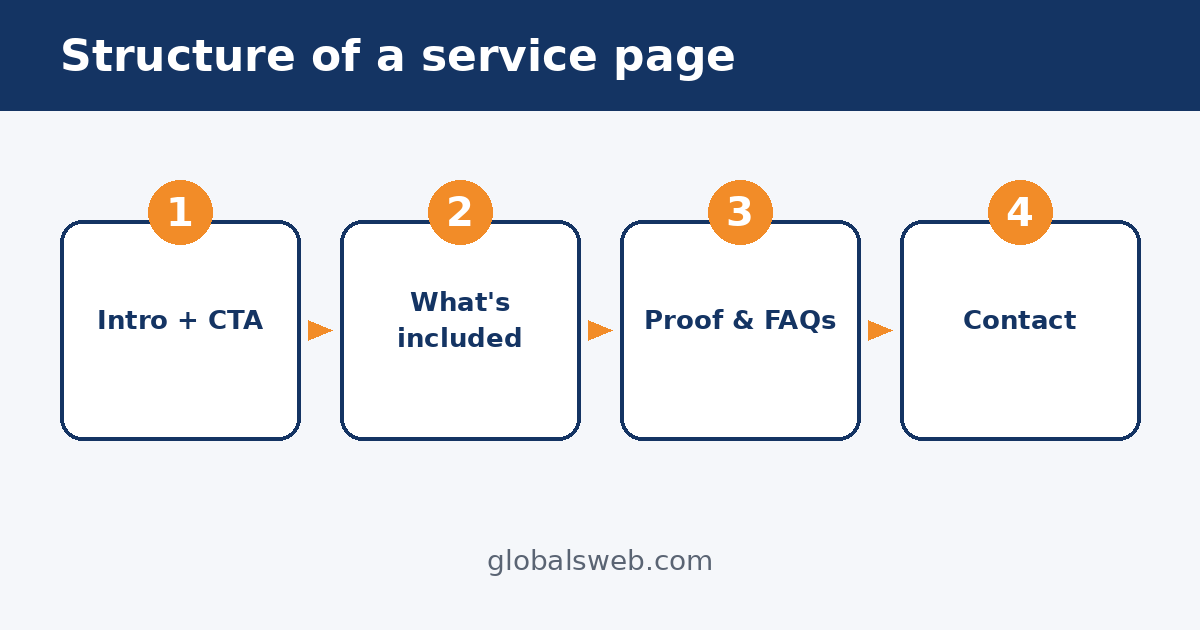
A good service page answers questions in roughly the order a customer asks them. A structure that works for most businesses:
- Headline and short intro. What the service is, who it is for and where you provide it, in two or three sentences.
- Primary call-to-action. A visible button to call, WhatsApp or request a quote.
- Problems you solve. Describe the situations that make customers look for this service.
- What is included. List the actual steps or deliverables.
- How the process works. From first contact to finished job.
- Why choose you. Real strengths such as experience, certifications, response time or local presence. Only claim what you can back up.
- Pricing guidance. If you cannot list prices, explain what affects the cost.
- FAQs. Short answers to the questions customers ask most.
- Final call-to-action with contact details.
Step 4: Write for customers first
Write as if you were explaining the service to a customer sitting in your office. Use plain language, short paragraphs and headings that say what each section covers. Include local details that matter: the areas you cover, whether you visit on site, your working hours and how quickly you usually respond.
Avoid filling the page with the same keyword over and over. Google is good at understanding related terms, and customers can tell when a page is written for search engines rather than for them.
A useful page for a competitive local service is often several hundred to over a thousand words, but length is not the goal. Every section should help the reader decide.
Step 5: Add trust and proof
Visitors want to know you have done this before. Honest proof might include:
- Photos of your actual work, team or premises.
- Short quotes from real customers, with their permission.
- Certifications, memberships or partner badges you genuinely hold.
- Examples of projects, described without exaggeration.
Never use fake testimonials, stock photos presented as your team or invented results. They damage trust when discovered and can break advertising and review policies.
Step 6: Get the technical basics right
Each service page should have:
- A unique SEO title (around 50–60 characters) and meta description.
- One H1 that includes the main phrase, with clear H2 subheadings.
- A short, readable URL such as /ac-repair-islamabad/.
- Compressed images with descriptive alt text.
- Fast loading on mobile and a tap-to-call or WhatsApp button.
- Internal links from your homepage, menu and related blog posts.
If your theme makes it hard to build flexible service pages, our web development team can create page templates you can reuse for each service.
Step 7: Link service pages and blog posts together
Blog posts that answer common questions should link to the related service page, and the service page can link back to the most useful guides. This helps visitors move from reading to enquiring and helps Google understand which page is the main one for each service. Keep the anchor text natural, such as “our SEO services in Islamabad” rather than repeating the exact keyword everywhere.
Step 8: Measure and improve
After publishing, check Search Console every few weeks. Look at which searches the page appears for, its average position and its click-through rate. If impressions are rising but clicks are low, improve the title and meta description. If visitors arrive but do not enquire, review the call-to-action, the form and the proof on the page. Service pages are never really finished; the best ones are updated as you learn more about your customers.
Common service page mistakes
- One page covering every service in a few lines.
- Copying text from competitors or manufacturers.
- No clear call-to-action above the fold.
- Many thin pages that only swap the area name.
- Claims that cannot be backed up.
Need help planning your service pages?
Well-planned service pages are the foundation of most local SEO work in Islamabad and make every lead generation campaign more effective. If you would like help deciding which pages to create and how to structure them, contact GlobalsWeb and we can review your current site and suggest a clear plan.